
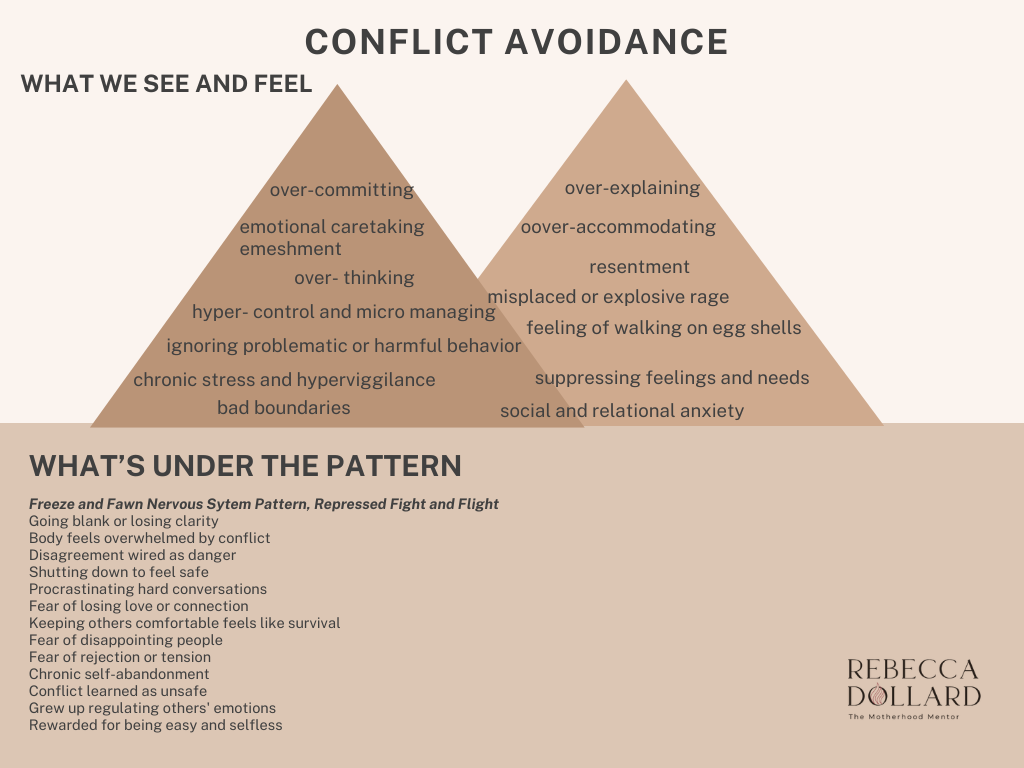
The people-pleasing, nervous system patterns, and family dynamics underneath conflict avoidance
Most people pleasers think they avoid conflict because they are “nice.”
But often, conflict avoidance has very little to do with kindness.
It has to do with safety.
For many women, especially high-functioning women raised in complicated family systems- conflict feels emotionally loaded long before adulthood. It’s why you are likely a highly intelligent and compitent woman at work or certain emotions and then feel so young, vulnerable, silly, or stuck in certain relationships with your parents, your partner, or even your own kids.
For women who are conflict avoidant a hard conversation can feel like:
- rejection
- disconnection
- danger
- abandonment
- failure
- proof that you are selfish or ungrateful
So instead of addressing the issue, you:
- over explain
- smooth things over
- accommodate
- suppress your feelings
- shut down and have nothing to say in the moment
- convince yourself it’s “not that bad”
- avoid the conversation entirely
And for a while, this can feel like peace. It’s not.
Over time, conflict avoidance quietly becomes one of the biggest things keeping unhealthy relational patterns alive.
Avoiding conflict rarely removes the problem.
It usually just pushes the conflict inward.
Into:
- resentment
- anxiety
- exhaustion
- self abandonment
- emotional shutdown
- disconnection from yourself
Not having healthy ways to navigate conflict is one of the most destructive patterns in a relationship. Because it actively ignores where there is harm and rupture.
This is problematic to the one swallowing their discontent, and also to the one they have conflict with. If other people don’t actively hear or see your no or your maybe. If you do not voice what does and does not work for you- you set them up to dissappoint you. You set them up to fail. To not know how to love you well. How to show up in relationship with you, even if that has changed or may be uncomfortable in the process.
Conflict avoidance is often a nervous system response
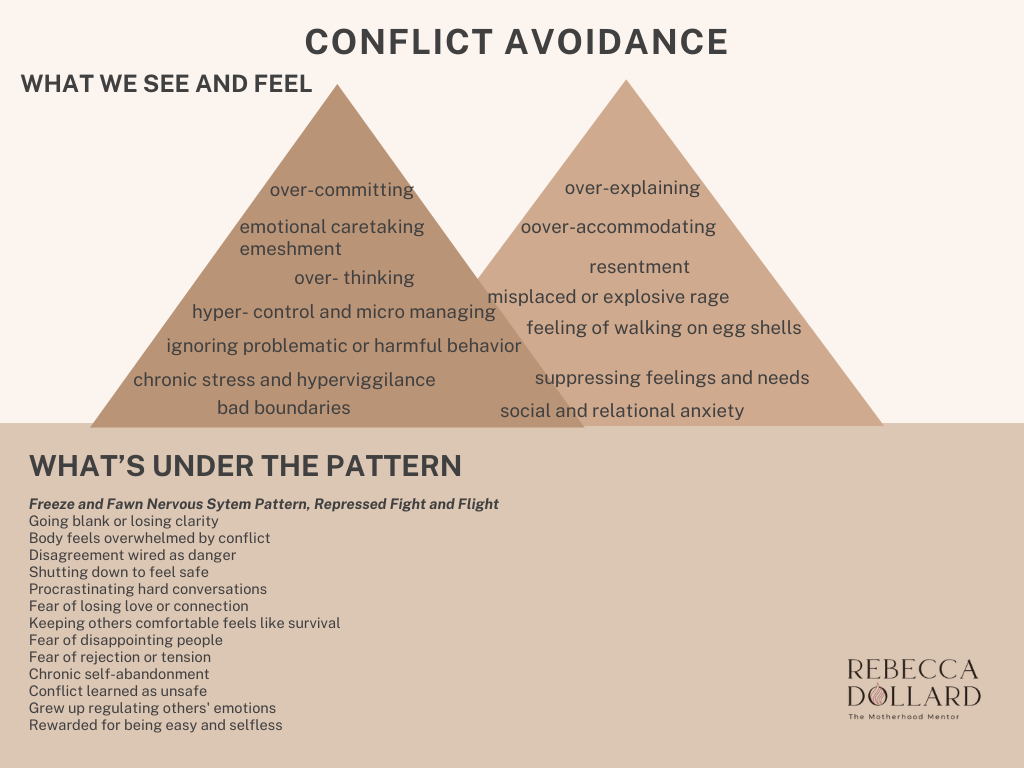
Most of us aren’t avoiding conflict out of kindness, but out of safety.
It’s important to remember here that our nervous system is not always reacting to the present moment. Many people are stuck in a pattern that once kept them safe but now keeps them stuck. If it’s hysterical, it’s often historical.
Your nervous system, your unconscious body, likely at some point learned that conflict was unsafe.
Maybe conflict in your home growing up felt:
- explosive
- unpredictable
- emotionally immature
- manipulative
- guilt heavy
- volatile
- withdrawing
- shaming
Or maybe there was never direct conflict at all.
Maybe tension was handled through:
- silence
- passive aggression
- emotional withdrawal
- over functioning
- keeping the peace at all costs
- performing good and grateful while they became a martyr to their own life
Children adapt quickly inside these systems. You have to as a child. Many a high functioning and highly ambitious woman learned this pattern as a little girl who was the one regulating her own parents.
You learn how to read the room.
Manage emotions.
Stay agreeable.
Become easy.
Ignore your own needs.
When connection feels uncertain, self abandonment can start to feel safer than honesty. When conflict with a parent feels impossible, it’s often easiest to learn to learn to hold yourself and the room under control. You take on that conflict internally, never letting it be seen or felt directly with others. This is so protective when you are a child. When you are in a situation where the other person holds power or position over you, and you know that their system will not hold that conflict or emotion or rupture well- so you self protect by taking on that conflict as an internal and personal problem to protect and fix on your own.
People pleasing is often conflict avoidance in disguise
A lot of women think people pleasing is niceness.
Sometimes it is.
But most often, people pleasing is a nervous system response of fawning or freezing.
It’s not an act of health, love, or genuine relationship.
It’s a well-intentioned pattern of protecting self and the unit from what feels like a threat. It’s root is in avoidance and fear.
Sometimes that fear is misguided. And sometimes it’s a reality. One of the main reasons people avoid boundaries is they don’t want to be mean, they don’t want to feel “bad”. Or more realistically- there is a deep seeded fear.
- fear of disappointing people
- fear of being misunderstood
- fear of tension
- fear of rejection
- fear of someone being upset with you
- fear of the grief that may truly happen when you tell the truth
So instead of saying:
“That doesn’t work for me.”
You:
- over commit
- over give
- over explain
- emotionally caretaking everyone else
- try to manage how other people experience you
Not necessarily because you want to.
Your nervous system learned that keeping other people happy helped keep you safe.
So when conflict shows up, your body automatically moves toward:
- smoothing things over
- over explaining
- emotionally caretaking
- softening your needs
- abandoning yourself to avoid tension
This is a nervous system response of fawning. Where you feel it happening to you. Not you being nice, but feeling like you could crawl out of your skin when you might be in conflict with someone else.
You shut down.
Go blank.
Lose clarity.Words get stuck in your throat. You forget what you were doing.
Avoid the conversation entirely.
Convince yourself it’s “not a big deal.”
Stay stuck in indecision because conflict feels overwhelming to your body.
In a freeze response, there is still a felt sense of bracing or activation. A live wire just under the surface that you feel, but can’t seem to act on. Some can also experience a freeze response where there is more of a shut down. In a shut down response, there is a lack of tone. There is a feeling of tiredness, being done, a lack of energy or lack of emotion. For some this can feel like a depression.
This is why conflict avoidance is rarely just a communication issue. It’s not just you having fancy right words to be able to say. But being in a body that has capacity to hold all the activation in self, other, and in the relational field.
Your nervous system may still believe disagreement equals danger, rejection, disconnection, or loss of love.
So instead of addressing conflicts, you disappear yourself inside it.
For most couples and families, when they are struggling, people recommend they learn to “communicate”.
People in a dysregulated state of freeze, fawn, fight, or flight cannot communicate or connect well no matter how good the words are.
Before any amount of repair, healthy conflict, or re-connection can happen- at least on person must be regulated and fully embodied in themselves. Ideally both people.
But no amount of “communication” work on someone disregulated. Imagine calming a toddler in the middle of a trantrum down with “logic”. Or how you instantly feel better when in the middle of a rage when someone tells you to “calm down”.
Ahhh yes, I never thought of that thank you. Conflict avoidance is rarely a logic or mental thing. It’s a somatic pattern. (Learn more about somatic healing here.) (Read more about the global no boundaries in this blog.)
Conflict avoidance keeps unhealthy family patterns alive
When we avoid minor conflicts, they become major. The minor little no’s become big global no’s.
This is one of the hardest truths and experiences around about cycle breaking. You must face and break the roles and patterns that were what protected and even prevented issues as a child.
Avoiding conflict often protects the very dynamics you are trying to heal.
When nobody names what is happening:
- unhealthy patterns continue
- resentment deepens and comes out sideways
- needs and desires are never names and can’t be solved for or met
- tension is avoided which prevents intimacy, connection, and vulnerability
- emotional immaturity stays unchallenged
- dysfunction becomes normalized
- over functioning gets rewarded
- boundaries never develop
- patterns continue to run even when they don’t work
And many cycle breakers find themselves carrying an enormous emotional burden because they are trying to create healthier relationships inside systems that were built around avoiding discomfort. Or you are carrying on this pattern in your own relationships and family and see how you want things different, but feel stuck trying to go against the grain.
Especially in families where:
- emotions were not tolerated well
- honesty felt dangerous
- individuality was seen as betrayal
- children became emotional caretakers
- guilt replaced accountability
- love became intertwined with obligation
In these systems, conflict can feel deeply threatening because conflict risks disrupting the family equilibrium—even if that equilibrium is unhealthy.
One of the biggest reasons people avoid conflict:
they do not want to feel like the bad guy
This is especially true for women who were rewarded for being:
- easy
- helpful
- selfless
- accommodating
- emotionally available
- low maintenance
At some point, many women unconsciously internalized:
“If someone is hurt by my boundary or even my needs or feelings, I must have done something wrong.”
You self blame, because the adults around you never took accountability for their impact on you.
Someone being disappointed or uncomfortable does not automatically mean you are unkind.
Someone having feelings does not mean you failed.
Healthy conflict requires allowing other adults to have their emotional experience without immediately collapsing into guilt, rescuing, or self abandonment.
And that can feel incredibly uncomfortable at first.
Conflict avoidance creates false peace
Avoiding conflict does not usually create real safety or healthy stable relationships.
It creates temporary relief. It creates dynamics where there cannot be solutions or repair, because the rupture and issues are never named or brought into the light. It creates families and relationships where no one feels connected but plasters on smiles. Where you feel even more lonely while surrounded. Rooms where you walk on egg shells.
Issues fester and grow with no one taking care of them. The tension often grows. It seeps out sideways.
You may avoid one hard conversation only to end up with:
- chronic resentment
- emotional distance
- burnout
- passive aggression
- anxiety
- relationship breakdown
- disconnection from yourself
- the need for no contact or space because the minors things build into major ruptures and explosive feelings or needs
What we refuse to address relationally often gets carried somatically, not just personally, but in the system and relationships.
The body keeps holding what the mouth will not say. And people pleasing is a part of this dynamic. There is often a felt power dynamic for people pleasers. A mistrust of how you will hold or respond if they don’t react well.
If you are avoiding conflict in your external relationships, you often need to start building comfort and confidence within your own internal capacity. You don’t have to feel fully safe. Just safe enough. If you are stuck in that fawning and freezing, you often have a repressed fight and flight that needs to be re-built and brought back online.
Healthy conflict is part of healthy relationships
Not all conflict is abuse.
Believe it or not, someone else having feelings about you or themself that are uncomfortable won’t kill you. Even if it feels like it might.
Not all tension means the relationship is unsafe.
Not all disagreement means rejection.
In fact, relationships without any conflict are often relationships where someone is disappearing themselves to maintain harmony.
Healthy relationships require differentiation. Healthy connection must include two separate individuals with their own needs, values, timing, and preferences.
If you want healthy conflict you must build the skills and ability to:
- stay connected to yourself
- stay honest
- tolerate discomfort
- repair after rupture
- allow differing perspectives
- communicate needs without collapse
This is part of cycle breaking too.
Not just refusing unhealthy behavior.
But learning how to stay present inside healthy conflict instead of automatically moving into:
- fawning
- freezing
- fixing
- appeasing
- avoiding
The grief underneath conflict avoidance
Sometimes avoiding conflict is not actually about the conversation that needs to be had.
Sometimes it is about what the conversation or the boundaries might reveal.
That someone may not change.
That someone may not understand.
That the relationship may need to shift.
That your old role in the family no longer fits.
Cycle breaking often includes grieving the fantasy that healthier relationships will come without discomfort. Humans often choose the pain we know over the one we don’t. We choose the familiar pattern and threat over the one we’ve never had to feel or hold yes.
But real change almost always disrupts old patterns.
Especially family patterns.
Especially generations of silence, guilt, emotional avoidance, or self abandonment.
Learning to tolerate conflict is part of learning to tolerate honesty
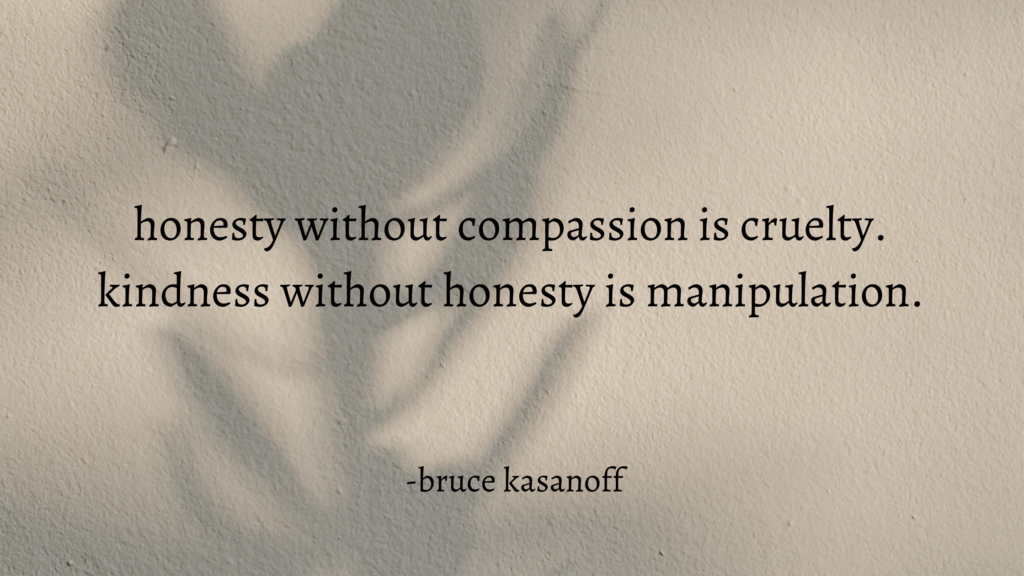
Conflict avoidance is rarely solved by finding the “perfect script.”
It is healed by slowly teaching your nervous system:
- discomfort is not danger
- disagreement is survivable
- someone being upset with you is not the end of connection
- you are allowed to have needs
- you are allowed to change relational patterns
- you are allowed to stop abandoning yourself to keep the peace
- other people’s emotions are not yours to control
When you are struggling with conflict and communication, it’s not just about the right words. It’s understanding the patterns of protection that are now keeping you stuck.
It’s learning to move discomfort. Choosing momentary discomfort over long term resentment.
Check out the Boundaries Integration Playlist on Spotify here.
If this blog felt like someone finally put words to what you’ve been carrying, you don’t have to navigate it alone. I help high-functioning women build healthier boundaries, nervous system safety, and relationships that no longer require self-abandonment. Work with Becca here.
Somatic Healing for High-Functioning Women: Why You Still Feel Stuck In Success