
There is a phrase that gets passed around personal growth spaces like it’s gospel:
“If it’s not a hell yes, it’s a hell no.”
It sounds clean and empowering. It affirms us away from our fear that we don’t know. It gives us the kind of certainty and clarity you have always wanted when it comes to setting healthy boundaries in relationships.
Until you try to apply it to your actual life.
Because most of us are not standing at some dramatic fork in the road, flooded with certainty about exactly what we want. It assumes that we don’t want multiple or even conflicting things at the same time. The push and pull of motherhood and my business ambitions comes to mind for me. Sometimes even what we want and need as an individual are at odds, then add in another person and their needs, or a business, or a client, or friend, or child- and what we get is less clear and simple.
Sometimes there isn’t a hell no, but a soft no. Sometimes we need more information. A hold on or a slow down. Sometimes what was a yes, can become a no. And something that used to feel like a “I could never”, becomes a, “well, what if I did?”
Most of the time when it comes to healthy boundaries- we are navigating the quiet, complicated middle – the relationship that drains us but also matters to us deeply, the invitation we feel obligation and desire toward at the same time, the conversation we know we need to have but can’t quite feel our way into yet. The boundaries we know we need, but that we can’t quiet find where or what they should be, yet alone how to communicate them.
That is where real, healthy boundaries in relationships actually live. The messy in between of consent, needs, desire, conflicts.
And “hell yes or hell no” has no language for that middle at all.
A lot of the time with boundaries- there isn’t a clear victim or villain. Sometimes we have to say no to good things at the wrong time. Sometimes we want to say yes to something that our body is clearly resisting.
Why the “Hell Yes or Hell No” Rule Breaks Down for Healthy Boundaries in Relationships
The phrase was meant to help people stop saying yes when they mean no. And for some situations — obvious violations, clear harm, requests that make your entire body recoil, people who are actively harmful or abusive in their behaviors — it does exactly that.
But it was never designed for the full complexity of setting healthy boundaries in relationships that actually matter to you.
This blanket statement assumes and asserts that:
- You always know what you want in real time
- Your feelings are immediate and legible
- Your capacity, desire, and needs are the same in each moment or season
- Anything less than full enthusiasm must be a no
- Your yes and your no are permanent rather than seasonal or situational
- The only people you need boundaries with are unhealthy or harmful
None of those things are consistently true for most people. And for women who have spent years over-adapting, people-pleasing, or operating in freeze and fawn, they are almost never true.
The binary also creates a shame trap. If you can’t locate the “hell yes,” the framework tells you it must be a “hell no” — so either you force a yes you don’t fully feel, or you withdraw completely from something that might actually deserve a softer, more honest response. Neither option honors the full truth of where you actually are.
What we need instead is a real map for how to set boundaries in the middle — the nuanced, situational, human middle where most of our relationships actually live.
The Spectrum of Consent: A Better Map for Healthy Boundaries in Relationships
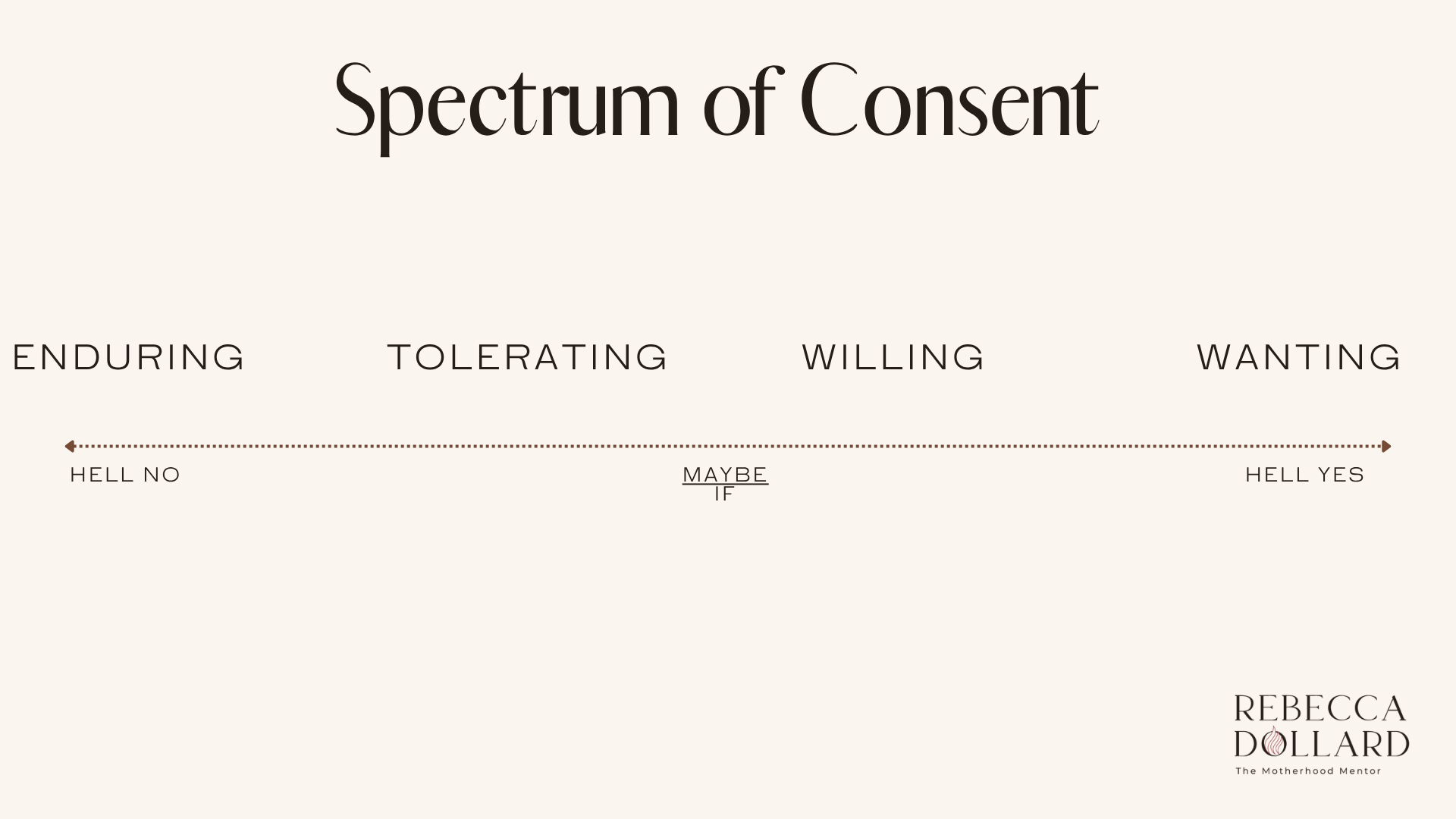
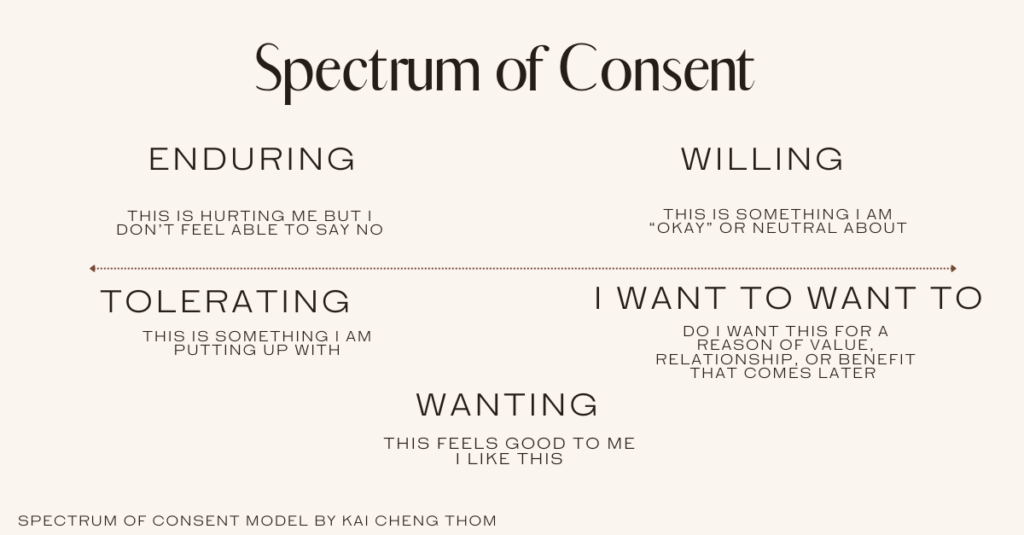
Somatic coach and author Kai Cheng Thom, drawing on the foundational work of Dr. Betty Martin’s Wheel of Consent, developed a model that does exactly that. Rather than collapsing all consent into yes or no, the Spectrum of Consent describes a full range of internal states — from enduring all the way to wanting — with a wide, honest middle between them.
This is one of the most useful tools I have ever brought into my work with women on setting healthy boundaries in relationships, because it finally gives language to the place where most of us actually live.
Here is what that spectrum looks like:
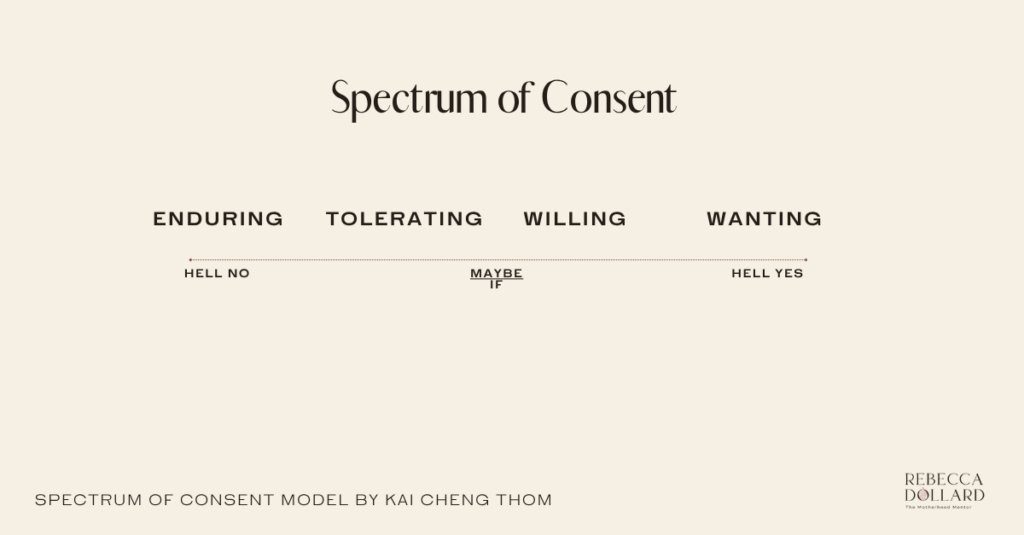
Enduring — This is the deepest no. Not just a preference, but a violation of your inner alignment. You are participating out of fear, pressure, or the belief that you cannot say no. Your body is bracing, not choosing. This is the place where resentment is born, where the self gets quietly abandoned over time.
Tolerating — You are not enjoying this. You are putting up with it, enduring it, getting through it. There may be a reason — obligation, loyalty, not wanting to rock the boat — but your consent is not rooted in desire or genuine willingness. You are surviving the experience, not choosing it. Setting boundaries in relationships often starts with finally being honest about how much time we have spent here.
Willing — This is the conditional maybe. You are okay with this. Neutral. Not excited, not resistant. You might be saying yes as a gift — because you love someone and want to show up for them even when it is not your first preference. Or because the conditions are right enough, even if the full enthusiasm is not there yet. This is a real and legitimate form of consent when it is freely chosen. Healthy boundaries in relationships include this place. Willing is not weak. Willing, chosen consciously, is an act of love.
“I want to want to” — This is one of the most human places on the spectrum and one of the least talked about when we discuss setting healthy boundaries in relationships. You do not fully feel the yes yet, but you are open to it. You can imagine getting there. With the right conditions — a slower pace, more safety, a shift in timing — the yes might arrive. This is not self-abandonment. It is the kind of maturity that knows the difference between what you feel right now and what you actually want.
This can also be those things that our body has a resistance, a no, a fear around that our values or will or desire have a yes to. Imposter syndrome can live here. So can re-parenting ourselves into a more healthy and mature place that sometimes self love and self care is saying no to a yes that will feel good now, but harm us later. Your kid may have a no to a vegetable and a yes to candy, but saying yes to candy all day all the time wouldn’t be love. This doesn’t mean we need the extremes of no or yes. But a sometimes yes, sometimes no. It depends.
Wanting — This is the enthusiastic yes. Full body. Clear. Something that genuinely feels good and that you actively desire. The classic “hell yes.” There is desire here and ALSO the capacity for it.
Healthy boundaries in relationships require you to be able to feel not only the desire for something, but the capacity for it. Whether you like it or not, you do have limits. Boundaries have to take into consideration our capacity of time, money, energy, space, fucks to give. We have limits. Real biological ones. Needs that can be inconvenient and uncomfortable to admit to ourselves and others.
Most of the work of building healthy boundaries in relationships does not happen at the two ends of this spectrum. It happens in the wide, honest, complicated middle — and that middle deserves a map. This is something you have to be able to feel. Boundaries start in your body. Your soma. Boundaries cannot just be around “good” or “bad” but the felt reality of our relationships.
Why Your Nervous System Makes Setting Boundaries in Relationships So Hard to Feel
A lot of women cannot feel their “no” in real time.
You cannot express, hold, or communicate a boundary you do not feel.
Not because you don’t have boundaries but because you have lost access to them. Lost the ability to feel them in your body, your emotions, your gut. Many of us learned very early to bypass and override the internal sense of consent and approval we were born with. How can you clearly express a yes or no, that you cannot feel?
Want to see someone who knows exactly how to hold a boundary? Find a toddler. That “no” is whole-body, immediate, and completely unapologetic.
But for many people, the nervous system learned early that expressing a no — on any level — was dangerous. In many families, a child’s consent was not a factor. Their needs, desires, and feelings were secondary — or invisible entirely. In homes where a clear power dynamic determined what was allowed and what wasn’t, where belonging meant orienting entirely to the other and never to self, where religious or cultural frameworks placed external approval permanently above internal experience — the body received a very clear message: your no is not safe here. Your no does not matter.
For some people, a healthy, connected no or boundary was never modeled, never witnessed, never permitted. And so the body never learned to feel or express it.
Instead of fight or flight, which are both, at their core, forms of boundary, the nervous system learned to survive through freeze and fawn.
In fight, the body moves against the threat — pushback, resistance, protection. This can be harsh and violent or as soft as when you swat a fly away from your face.
In flight, the body moves away from the threat — withdrawal, distance, escape. This can be walking away, pausing, or as intense as fleeing with intensity.
In freeze, the body stops. There is activation without mobilization – a “too much” feeling without the felt ability to move, a system caught between impulses.
In shutdown, the body goes still and numb, playing dead, conserving by not feeling. This can look or feel like a low or high level burnout or even depression.
In fawn, there is a freeze/dissociation from self first, and then a move toward the threat — to appease, please, soothe, seduce, or manage the other in order to create safety for self.
Fawn and freeze are often misread as people-pleasing — as though the person is simply being kind, accommodating, or conflict-averse by nature. But this misses what is actually happening beneath the surface.
Fawn and freeze are not about being nice. They are survival strategies organized around avoiding an internal experience of the dread of conflict, the weight of guilt, the fear of rejection, the anxiety of someone else’s disappointment or anger. For some, they are organized around something even more fundamental: an unexamined but deeply held belief that it is not safe to have needs, to disappoint, or to be truly seen in conflict. You know when you say yes in the moment and then later realize you resent it? Or you said “that’s okay!” even when it was definitely NOT okay? That’s often fawn or freeze at work.
You cannot have healthy boundaries in relationships when you are stuck in fawn or freeze. Most people stuck in these states had a very real past experience or relationship where they did not have the power, access, or ability to run or fight. They were stuck. This is when the body moves into the more complex and relational responses of freeze and fawn.
Fawn, in particular, is not selfless. It’s not niceness. It’s not about pleasing others. It is a way of getting needs met (connection, safety, approval, relief) through managing and manipulating the state of the other. Not out of malice, but out of necessity. If I can keep you calm, keep you happy, keep you from pulling away, then I am safe. If I can manage your emotions, I may avoid your meltdown or explosion or violence. Maybe, there is a way I can be good enough to earn your approval. So the animal/ unconscious self represses it’s own emotions, needs, and desires and meshes in the state, mood, and desires of the other.
The fawn response learned early that the most reliable path to having needs met was not through direct expression, but through making the other person feel good enough that they would stay, give, or soften.
This is why fawn can be so hard to recognize in yourself. It feels like generosity. It can look like being a good partner, a good friend, a good daughter. This is often why boundaries can feel so bad. The cost of the self that got left behind in the process, only shows up later, in the resentment, the exhaustion, the creeping sense that no one actually knows you.
These responses are most often called “trauma responses,” but that framing is incomplete.
Fight, flight, freeze, shutdown, and fawn are not pathologies. They are energetic movements — the body’s dynamic relationship between self and other.
What kept you safe, may now be keeping you stuck.
There is a healthy version of every single one of these movements. There is a healthy moving against: pushback, tension, advocating for what is right, protecting yourself or someone else. There is a healthy moving away: discernment, space, knowing when to leave. There is a healthy stillness: reflection, restraint, the pause before a considered response. There is a healthy movement toward: repair, warmth, connection, care.
The trauma is not in the movement itself. The trauma is in losing access to the full range of movement. The problem is in getting locked into an over- or under-response that no longer fits the present moment. When the nervous system is stuck, it is not responding to what is actually happening now. It is responding to a past threat that has long since passed. What once kept you safe is now keeping you frozen.
This is why healthy boundaries in relationships can feel so impossibly hard. It is not weakness. It is not passivity. It is a nervous system doing exactly what it learned to do: stay in the relationship, even at the expense of staying in the self.
When your boundaries, the maybes and the nos that can’t be felt, and therefore can’t be spoken- they don’t disappear.
They get stored. They become your posture and even an identity.
- In resentment that builds slowly, then erupts at the wrong moment on the wrong person
- In a feeling of near-constant vigilance, hypercontrol, and a mental load that never fully lifts
- In exhaustion that makes no sense given the facts of the day
- In a vague, chronic sense of being too much — or not enough — after time with certain people
- In the urge to completely withdraw from a relationship without being able to name exactly why
- In the sudden desire to go fully no-contact, when what was actually needed were a dozen smaller, earlier conversations
This is what freeze looks like in relationships- going blank during conflict, feeling fine in the moment, and then having the full weight of what happened land hours or days later, when it’s harder to address and easier to question yourself.
This is what fawn looks like- saying yes while internally collapsing, managing everyone else’s emotional weather so fluently that even you can’t locate your own.
This is also why so many women swing from no boundaries at all to a sudden, total withdrawal — a “global no” — rather than being able to name the specific, smaller things that needed to shift along the way. The small signals were overridden for so long that the only one left loud enough to hear is the overwhelming one.
The “hell yes or hell no” framework is sometimes useful, but it assumes you have real-time access to your yes and your no. If your nervous system learned that your nos were not safe to feel or express, you may be navigating your relationships from a very partial map of your own interior.
The work of somatic, embodied boundaries isn’t about learning the right words or the right script. It’s about rebuilding the capacity and skill to feel the small things, to notice the moment something lands wrong, before it accumulates into a weight you can no longer carry. And then being able to move from that knowing and feeling. To be able to make a fist, ask a question. To build a healthy capacity and relationship to conflict and boundaries in reltionship without feeling like you are going to die.
It’s learning to trust the quiet signal before it becomes the only signal left. Not the boundary that arrives as a breaking point but the one that arrives as a whisper, early enough to actually change something.
Not just a hard no and a fist, a bridge to keeping connection to other and self.
When Breaking Your Own “No” Is the Healthy Thing to Do
Sometimes you will choose to do something you don’t fully want to do right now. And that can be a completely healthy, mature, values-aligned choice.
“Hell yes or hell no” has no room for this. But real life and real relationships are full of it.
Here are some real examples of what that actually looks like when you are actively working on setting healthy boundaries in relationships:
The gym you don’t want to go to. You are tired. You would rather stay on the couch. There is no hell yes here- there is barely a yes at all. But you go anyway, because a part of you knows how you will feel after. You trust the version of yourself who made the commitment more than the version who wants to skip it today.
This is not a violation of your boundaries with yourself. That is integrity with your own values, even when it is uncomfortable. That is a healthy boundary in relationship with your own body and your own word. Another day, the healthy boundary is saying no to the gym because the need of rest matters more than last weeks idea of what would be “good” for you.
The hard conversation you keep avoiding. You do not want to have it. Your stomach tightens at the thought. The freeze response kicks in and says not today, not like this, maybe never. But you know the resentment will keep building without it. You know the relationship needs this truth. So you move toward it. Not because it feels good right now, but because you want the relationship that exists on the other side of the discomfort.
Learning how to set boundaries in relationships often means moving toward the hard thing while still in the “willing,” not waiting for the hell yes to arrive first. Sometimes the scary things- starting a podcast, writing a blog, going on a first date or a last one- feel like you are about to tip over the edge of the roller coaster. That feeling, while uncomfortable, isn’t always a harmful thing.
The holiday gathering you attend out of love. You are tired. Your family is complicated. Part of you would genuinely rather stay home. But you also love these people, and showing up matters to you, and you are willing to spend energy here even when your personal preference says otherwise. As long as you are genuinely choosing it – not collapsing into it, not silently abandoning yourself to get through it- this is a “willing” on the spectrum. And willing, freely chosen, is a legitimate and loving form of healthy boundaries in relationships. You are not betraying yourself. You are showing up as someone who chooses love even when it costs something.
I’ve never “wanted” to catch puke in my hands, but I’ve done it out of a mothers love.
The season of life when you slow down. You built something at full speed and the hell yes was real and it carried you forward. Then something shifted- maybe motherhood shifted your ambition or capacity, a child’s needs changed, your body started asking for rest, the joy went quiet.
The thing that was a hell yes became a conditional maybe. This is not failure. That is your capacity and boundaries in relationship changing, your season changing, you changing. The honest response is not to force the old yes or dramatically blow it all up or get mad at past you or them. Now you need to locate what “willing” or “I want to want to” looks like in this new reality, and to let your healthy boundaries in relationships with your work, your time, your commitments, and your own body reflect that truth with honesty and without shame.
The intimacy you move toward before you are fully there. You love your partner. The desire is not present right now- but the love is, and the openness is, and with the right conditions the desire might arrive. You ask for what you need to get there. A back rub that is actually a back rub. Time to land in the same room together.
That is not self-abandonment.You want to want to. You may not be all hot and ready, but there is an invitation or question or bridge that is open for them to pursue or for you to warm up. That is being honest about where you are on the spectrum and trusting that the conditions can shift. That is setting a healthy boundary in the relationship- one that honors both you and them.
In every one of these examples, someone is moving toward something she does not fully want yet- or something she once wanted that she no longer does- from a place of values, love, maturity, and real agency. That is not the same as enduring or tolerating. The difference is that she knows where she is on the spectrum, and she is choosing it anyway, with full honesty about the cost and the reason.
That is what healthy boundaries in relationships actually look like in practice. Not always a triumphant or “hell no”. Sometimes a clear, chosen, honest willing.
When a No Becomes a Yes — And Why Setting Boundaries in Relationships Means Letting Them Move
Consent is not always a one-time declaration. Boundaries can move. They can soften or intensify. Boundaries and healthy relationships respond to context, capacity, season, and growth.
This means that a no from last year is not necessarily a no today. And treating a boundary as permanent, as though changing your mind means you were wrong before or are being inconsistent now, is its own kind of rigidity. It is the “hell yes or hell no” trap showing up in a different form: the belief that a real or a healthy boundary has to be forever.
Some real examples of healthy nos becoming genuine yeses in relationships:
You said no to something for years. I need my time. I am not that kind of person. That is not for me. And then something shifted in your life, in your capacity, in your understanding of what you actually want and need. The no had been real. And the yes became real too, in a new season, for new reasons. You did not betray yourself by changing your mind. You trusted yourself enough to be changed by your own growth. That is how setting boundaries in relationships is supposed to work. There is a trust of self and other that is responsive and not just fixed in fear or control.
You took distance from a relationship. The space was real and necessary. And then, slowly, something shifted in them, in you, in the dynamic between you. You found yourself more open than you expected to be. The wall softened into a door. The door became a window. That movement toward is not weakness or capitulation but sometimes a willingness to stay in relationship with the reality of who someone is now rather than a fixed story about who they were. Healthy boundaries in relationships are allowed to open as well as close. Maybe they never changed or healed, but you did. And now you have enough capacity to be in relationship without self abandoning.
You turned down an opportunity once. The timing was wrong, your capacity was gone, the no was true. Then it came around again and something in you moved differently. The circumstances had changed, your energy had returned, the yes was genuinely there now. None of that means the original no was a mistake. It means you were paying attention both times. That is the whole point of learning how to set boundaries. It’s not finding the permanent answer, but trusting yourself to find an honest one, even as it changes.
The goal in building healthy boundaries in relationships is not to become someone who always knows the right answer from the beginning. There isn’t always a perfect define the relationship conversation that fixes it all.
The goal of boundaries work is to become someone who trusts herself to notice when something has changed and who gives herself permission to respond to the truth of this moment rather than the truth of an earlier one.
What Healthy Boundaries in Relationships Actually Ask of You
The Spectrum of Consent is not just a framework for figuring out what to say to other people. It is, first and most importantly, a tool for coming back into honest relationship with yourself, which is always where setting healthy boundaries in relationships has to begin.
Before any conversation, any decision, any limit you are considering, consent asks you to pause and locate where you actually are. Not to perform a feeling you think you should have. Not to find the “right” answer. But to feel, honestly, where you are right now with this specific person, this specific dynamic, in this specific season of your life.
Some questions that help with that:
- Where am I on this spectrum right now- really?
- What am I doing, and who am I doing it for?
- Is this a no because it violates my values, or because I don’t have capacity right now?
- If I had more capacity, would the answer be different?
- Am I in enduring or tolerating because I feel I can’t say no- or am I choosing this as a gift?
- What is my resentment or exhaustion actually pointing me toward?
- What would it take for me to move from where I am toward where I want to be?
- Is this a boundary I need to set with someone else – or with myself?
Enduring and tolerating, when they are compulsive- when you genuinely cannot find the no, when the yes is a collapse rather than a choice- come from fear. Fear of conflict, rejection, of being too much or not enough, of losing the connection entirely.
Willing and wanting, when they are genuine, come from love. Love for another person, love for your own values, love for the version of yourself you are still in the process of becoming.
Boundaries work gets to grow with you. Shifting, changing, and adapting as your yes and no change.
Setting Healthy Boundaries in Relationships Means Setting Them While Feeling Bad
One of the most common questions in this work: How do I set a boundary without feeling bad?
The honest answer is: sometimes you don’t.
Sometimes you set the healthy boundary in the relationship while feeling grief, sadness, discomfort, the particular loneliness of telling the truth in a relationship that was not built for it. And you set it anyway. Not because the discomfort is proof you’re doing the right thing, but because the discomfort is proof you are finally being honest even if it costs comfort and convenience for you or for the other.
When you stop playing the role your family system assigned you, there will be discomfort. When you stop overfunctioning, stop managing everyone else’s emotional weather, stop abandoning yourself to keep the peace- there will be tension. You are changing a relationship. That tension is real, and it belongs there. That rub between you and the other is a tenant of healthy relationship. I know it can feel like you are going to die, but the chances are- you are just going to feel massively uncomfortable for a bit and then feel the relief and true peace that often lies on the other side of rupture and boundaries work.
Avoiding discomfort does not create peace. It just delays the rupture while quietly teaching your body that your needs do not matter and no healthy boundary in any relationship can grow from that soil.
The Spectrum of Consent gives you a way to stay in the discomfort without either collapsing back into the old pattern or blowing the whole thing up. You can be in willing. You can be in “I want to want to.” You can be in the honest, uncomfortable middle while still in motion, still in the relationship, still becoming someone who knows how to set healthy boundaries in relationships without losing herself in the process.
You Are Allowed to Change — And So Are Your Healthy Boundaries in Relationships
Perhaps the most freeing thing this framework offers is this:
Your yes and your no are allowed to move.
Not because you are inconsistent or unreliable but because you are alive. Your capacity changes. The people you love change. Your seasons change. You change. And healthy boundaries in relationships are supposed to change with you.
A thing that was a hell yes at 28 might be a willing at 35 and a gentle no by 40. That is paying attention. What worked for you in the winter may not be enough in summer. What felt so good in fall, will be too much when you are in spring.
A thing that was a clear no for years might slowly, honestly, become a willing, and then a wanting. That is not weakness or self-betrayal. That is the self-trust that grows when you know yourself well enough to recognize when something real has shifted and when you are brave enough to say so. That is maturity. Healing. That is being humans in messy relationship to themselves and others.
The goal is not to become someone with perfect, permanent, unwavering boundaries. The goal is to become someone who trusts herself enough to notice when something no longer works in a relationship and to respond in real time to that truth with honesty, care, and the willingness to keep feeling her way toward what is actually real.
That is what embodied, somatic, healthy boundaries in relationships actually feel like from the inside.
Not always a “hell yes”, or a “hell no”.
A messy middle maybe. A question. A pause.
Needing a playlist for your Boundaries Era? Listen here
Listen to the podcast episode around this topic to dive in further.
This is part of an ongoing series on healthy boundaries in relationships. Read more blogs about boundaries here.
Want 1:1 support and coaching to get better with boundaries, relationship, or nervous system regulation? Somatic Coaching